SFTPK: Red/Black Trees


This post is one in a series of stuff formally trained programmers know—the rest of the series can be found in the series index. Building off the Binary Search Tree, we get the red/black tree, which aims to solve the problem that a BST can become unbalanced. The short version of a red/black tree is that it is a BST with a set of rules that help us keep it performing well.
Thinking back to the BST, when we are doing inserts and deletes, at some point we need to rebalance the tree to ensure we keep that sweet O(log n) performance for searching. When is the right time to do that rebalancing?
A red/black tree extends a BST by adding one bit of information to each node; for those keeping track, our node now has the data, a key, and a flag. The flag is either red or black, and there are 7 rules for a red/black tree (there are 5 official ones that relate to the colors, the first five below, but there are two more for the BST itself):
- Each node is either red or black.
- The root node is black.
- All leaves are black. These leaves can be the null pointers off of a node or they can be explicit nodes.
- A red node can only have black children.
- Any path from a node to the leaves contains the same number of black nodes.
- New nodes added are always red.
- If the depth of a path is more than twice that of the shortest path, we need to do a rotation.
So with these rules, insert & delete get more complex because you need to check them and, if the rules are violated, you start to correct the issue. What’s great is that because of the rules, you become really efficient at correcting the problems.
So let’s look at a really simple BST:
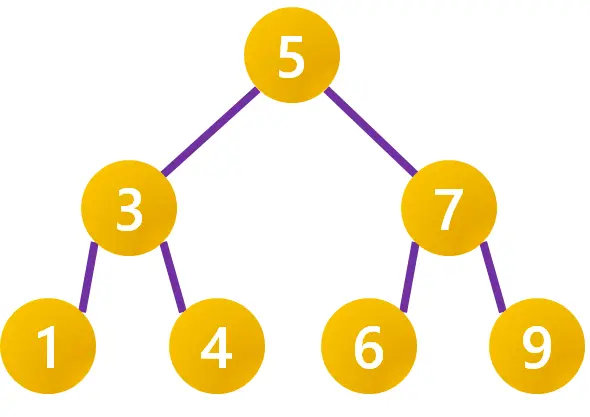
Next, let’s make it a red/black tree following our rules above. I am also going to add the leaf nodes in this image to help explain it but will remove them in the remaining ones.
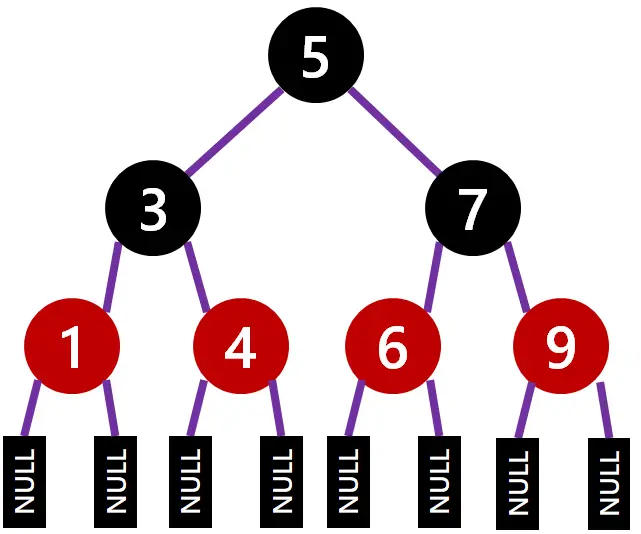
Note:
- From the root node, you need to go through 1 black node to reach a leaf node, regardless of path.
- All red nodes only have black children.
- A black node can have black children.
Now we are going to add a node with value 11. It is added in the correct place and as a red node.
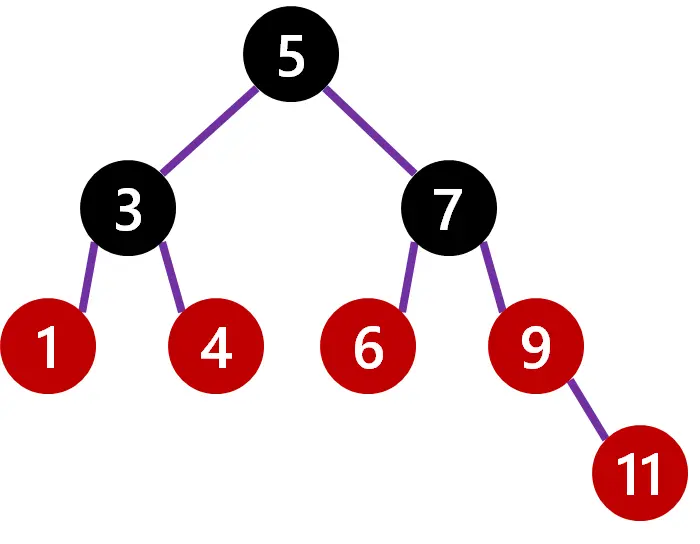
However, 9 is red and has a red child, so we need to trigger a repaint of 9 to black. That causes a new issue: from the root node to the leaves, you may go through 1 black node by going left or 2 black nodes by going right, so we need to paint the parent of 9 (i.e., 7) to red. Lastly, since 7 is now red, 6 must be repainted to black. Finally, we have a correct red/black tree again.
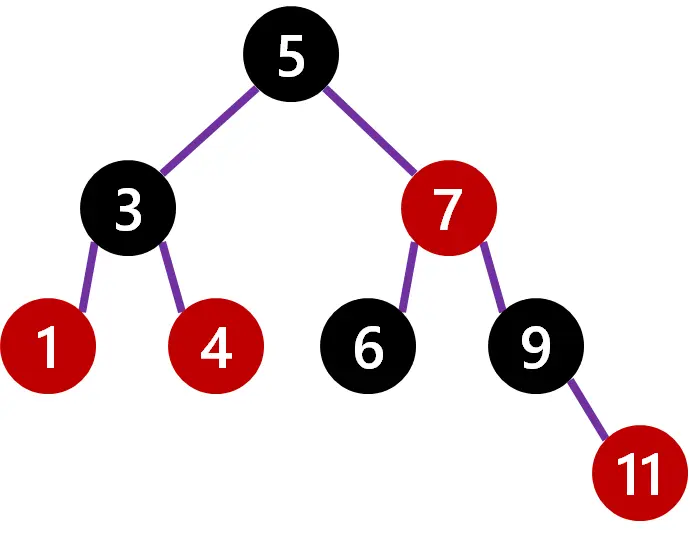
Lastly, let’s add 10, which goes under 11. Immediately, we note that the length from 5 to the leaf of 10 is 4 steps, while the shortest path (the left side) is 2. We know we need to do a rotation.
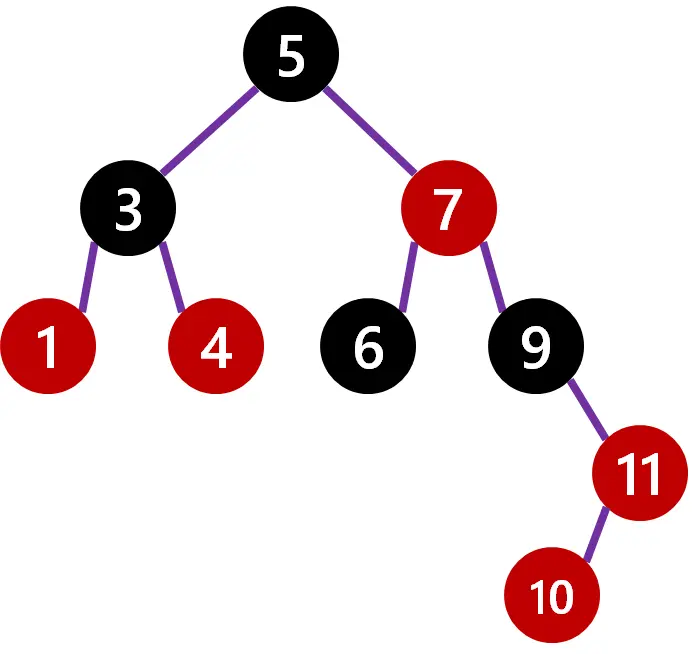
The rotation is easy: we take the child of the longer side (i.e., 7) and make it the root, and make the original root (i.e., 5) a child of it. Since 7 already has two children (5 and 9), its original child 6 moves under 5. Next, we just trigger a repaint, starting with the fact that 7 needs to be black, and you end up with the following:
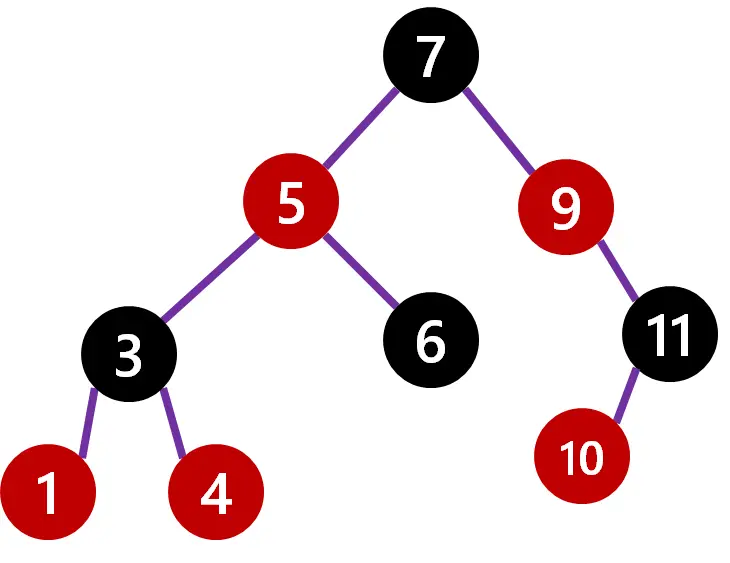
This might seem really expensive to do, but since you are just changing pointers and only a few of them, the performance of the insert becomes also O(log n).
Implementations
Unfortunately, neither Java, .NET, nor JavaScript has out-of-the-box implementations, but there are plenty available if you search for them.