Welcome to this update
For over 17 years I've used Drupal but today marks the first day this website is not powered by it 🤯 It is running on a static HTML system called Lume.
If this is your first or 100th visit, welcome.
Why the change
Drupal
When I picked Drupal so long ago, it made sense... Drupal was also a move for me away from handcrafted systems (at one point using ISAPI DLLs coded in Delphi) to a system which would be easier to use and just work... and so picking it was easy choice.
And it all worked wonderfully, and as Drupal grew in versions and got new features, so did I.
In the last 2 or 3 years though, it has gotten wobbly - countless version updates to the core and plugins have left the in an odd space. Drupal change to more modern development practices also changed how they wanted it used. Plugins deprecated or broken.
The biggest issue recently has been the Markdown rendering just breaks on every update and takes ages to fix.
And for a long time, I've been of the mind, just fixing it is quicker than moving away... until the hurt of always fixing was getting a bit much.
Drupal is probably great, but unless I started fresh, I do not think I would ever have real trust in it.
Hosting
When I picked a web host 17 years ago, they were one of the top for Drupal hosting and the experience with support was amazing. They were also super cheap.
Last year though I got a 25% price increase. Support is less than ideal. They can't do anything to update the MySQL DB I was using cause it is shared hosting, so I was stuck with a painful move if I wanted to keep it updated.
It has just been stacking up that once they were ideal, but now... less so.
Why Lume
Why pick Lume over everything else... it was Lume or Astro... and after trying both Lume was easier to use. Thats it. I think Astro is probably as good.
Having static HTML generated was the goal since it means I can host on any number of exceptionally cheap (or free) providers and I don't need a LAMP stack for a blog.
Migration Journey
If you are interested in how I did it... it was a journey and involved building lots of scripts to handle things.
- First I exported the DB and built a small tool to load it into a DenoKV store. I limited it to handle just blog posts. I did this so I could easily work with, as I knew I would have to do multiple steps in the journey.
- The old site has a mix of different formats for the content, mostly HTML and Markdown, so using mdream I migrated it all to Markdown. I then used a local AI model to help double check and clean the Markdown. I also had the AI build a description for all the posts, something which I almost never had before.
- During this process I reviewed all the content and dropped a lot of the old posts as they either were nonsense or they they time specific things like Event this Saturday, RSVP here. I think the final set over over 620 blog posts here is much better. There is a lot of content which is not relevant, like old CRM and SharePoint, but I think keeping it is interesting to reflect on... and maybe someone, one days, wants to setup an digital museum and runs into those issues.
- Using A LOT of find and replace in Visual Studio Code, I manually fixed up a lot of path issues (like making all the images use relative paths so I can test fully locally) and general cleanup of the Markdown.
- What mdream didn't handle was
<embed> and <iframe> tags, so I needed to re-process all the data to find them and then I manually added them to all the new Markdown files. In a lot of cases, I couldn't just copy/paste... because the iframe was pointing to dead content or, worse, FLASH! I was amazed how much of what was embedded was Flash. In all those cases I had to figure out the new urls and clean it up. This meant a lot of just broken content, is again working. I had not thought this would be the case when I started. - Taking the opportunity to clean things up I made use of ImageMagick to change all images from png/jpg to webp and strip out any exif info. There is no point having fast HTML with slow image formats.
- At some point in Drupal's life they changed where files uploaded went, which meant I had 2 folders with almost the same content in, so making use of FDUPES I was able to delete all the duplicate items.
- Using the Lume Check URLs plugin I then manually fixed up any broken links to images or files. This was also important since there were some URLs in posts which pointed to the wrong thing entirely. This meant that by the end of this I had fixed up issues I didn't even know I had.
- The biggest issues in this was Drupal had the ability to add attachments to posts, and at some point around 2023/2024... any ZIP file added to a post was deleted from the server... and I have no backups 😭 So back to the DenoKV to build another tool which found any attached zip files and then tried to get them off of the WayBackMachine. In the end there were two that are lost to time, the first is a ZIP of a completed demo (not too bad), but the other was the latest version of the South African ID Number Excel Spreadsheet. I was able to get an older version but the latest one is gone 😭
- And through out all these steps, just looking at blog posts and fixing up the content as I went was manual.
All in all this took about 50 hours to do and lots of once off scripts, and SO many regular expressions.
AI
You'll see that I used AI to help with this change, and in all cases I ran a local model to help. It was hit and miss to be honest but overall it sped things up.
Beyond the descriptions (for migrated items - this posts description is hand made), all AI was used to do was help migrate content. I probably could've avoided it with more tools and scripts, but the trade-off was not really worth it.
Storage
Previously the website took almost 800Mb on disk! Now it is a slim 140Mb, thanks to all the de-duplication and removing of things which are not used anywhere anymore. Really happy with this saving, even though it means not much.
Thats it
Hopefully now that everything is just a collection of Markdown files, the next time I need/way to change things... it will be much easier.
So that is why I moved websites, and how I did it. If you have questions or thoughts on it why not email me.
This is a bunch of notes around dealing with dependencies in Maven based projects.
Background Info
Before we start here are some useful background info.
SemVer
SemVer is a versioning standard which should help make clear when a package update is safe to use, this is why the below has -DallowMajorUpdates=false to limit to minor or patch updates as documented by SemVer
- Patch version Z (x.y.Z | x > 0) MUST be incremented if only backward compatible bug fixes are introduced. A bug fix is defined as an internal change that fixes incorrect behaviour.
- Minor version Y (x.Y.z | x > 0) MUST be incremented if new, backward compatible functionality is introduced to the public API. It MUST be incremented if any public API functionality is marked as deprecated. It MAY be incremented if substantial new functionality or improvements are introduced within the private code. Furthermore, it MAY include patch level changes. Patch version MUST be reset to 0 when minor version is incremented. So public API calls should be fine with minor and patch releases, with patch releases going even further to being fully backwards compatible. Major releases though maybe incompatible
Major version X (X.y.z | X > 0) MUST be incremented if any backward incompatible changes are introduced to the public API. It MAY also include minor and patch level changes. Patch and minor versions MUST be reset to 0 when major version is incremented.
Maven Nearest Definition Wins
Maven has a strategy to pick which dependency it will use where there are multiple dependencies of different versions are found. In this it does not pick the newest version based on the version number, but rather it will pick the one closet to the project. For example if your project A has dependency B and E directly added and both of them use a dependency called D, but B uses it via C and E uses it directly, then the version used by E will win, regardless of version number. Visualised, in this scenario you will get 1.0 of package D loaded, even though 2.0 is newer. This will could cause the code in C to fail, if it uses anything new or changed in 2.0. If it uses only things from version 1.0 then it would be fine... but any update to B or C in the future could suddenly cause a failure.
 A
  ├── B
  │   └── C
  │       └── D 2.0
  └── E
      └── D 1.0
When multiple have the shortest path, it picks the first path in the pom.xml, for example here F and B both bring in D and the path is the same length (2 steps).
 A
  ├── com.demo.F
  │   └── D 2.0
  └── org.other.B
      └── D 1.0
If the pom.xml had this order
<dependencies>
  <dependency>
    <groupId>com.demo</groupId>
    <artifactId>F</artifactId>
  </dependency>
  <dependency>
    <groupId>org.other</groupId>
    <artifactId>B</artifactId>
</dependency>
It would load version 2.0 of D because package F was first in the file.
Check for new releases
The following command is a good way to see what is available to update. It takes an absolute age the first time you run it
mvn versions:display-dependency-updates -DprocessDependencies=true -DprocessDependencyManagement=false -DallowMajorUpdates=false
Avoid transitive dependency issues
The big risk in an update is the transitive dependency, for example if com.demo:package:0.1.0 and org.other:package:0.2.0 both use com.demo:depoendency:0.1.0 internally - that dependency package is a transitive dependency of both. It will work since they both use the same version. It can cause issues when doing updates when one is updated and another not, for example if we switched to com.demo:package:0.2.0 which uses com.demo:depoendency:0.2.0 internally but org.other:package:0.2.0 still is looking for the 0.1.0 release it MAY cause issues. It really depends on what the second package uses, in some cases it could be a problem and in others not. To illustrate this lets look at some real examples.
Example: GRPC
io.grpc:grpc-api:jar:1.70.0 is used by com.google.cloud:google-cloud-spanner:jar:6.93.0 and io.grpc:grpc-okhttp:jar:1.70.0:compile If we were to upgrade io.grpc:grpc-okhttp to 1.82.1 it would break the Spanner code because the GRPC must always be the exact same. mvn dependency:tree -Dincludes=<package you looking for> can help find these, for example
mvn dependency:tree -Dincludes=io.grpc
...
[INFO] com.demo:package:jar:1.0.0
[INFO] +- com.google.cloud:google-cloud-spanner:jar:6.93.0:compile
[INFO] |  +- io.grpc:grpc-api:jar:1.70.0:compile
[INFO] |  +- io.grpc:grpc-auth:jar:1.70.0:compile
[INFO] |  +- io.grpc:grpc-inprocess:jar:1.70.0:compile
[INFO] |  +- io.grpc:grpc-core:jar:1.70.0:compile
[INFO] |  +- io.grpc:grpc-context:jar:1.70.0:compile
[INFO] |  +- io.grpc:grpc-util:jar:1.70.0:runtime
[INFO] |  +- io.grpc:grpc-protobuf:jar:1.70.0:compile
[INFO] |  +- io.grpc:grpc-protobuf-lite:jar:1.70.0:runtime
[INFO] |  +- io.grpc:grpc-stub:jar:1.70.0:compile
[INFO] |  +- io.grpc:grpc-opentelemetry:jar:1.70.0:compile
[INFO] |  +- io.grpc:grpc-grpclb:jar:1.70.0:compile
[INFO] |  +- io.grpc:grpc-xds:jar:1.70.0:runtime
[INFO] |  +- io.grpc:grpc-services:jar:1.70.0:runtime
[INFO] |  +- io.grpc:grpc-alts:jar:1.70.0:compile
[INFO] |  +- io.grpc:grpc-googleapis:jar:1.70.0:runtime
[INFO] |  \- io.grpc:grpc-rls:jar:1.70.0:runtime
[INFO] \- io.grpc:grpc-okhttp:jar:1.82.1:compile
...
Note it is clear from this that they have diverged and this will cause issues. In this scenario we should NOT do the okhttp upgrade. You're maybe asking at this stage, why GRPC does not follow SemVer as 1.70 should be compatible to 1.82... but it is just public API calls that are compatible with minor releases, but SemVer splits the public API and the transport layer so calls to io.grpc:grpc-core are internal, according to their README and thus won't be compatible. GRPC patch updates should be compatible.
Example: protobuf-java
Using mvn dependency:tree -Dincludes=com.google.protobuf we see
...
[INFO] com.demo:package:jar:1.0.0
[INFO] +- com.google.cloud:google-cloud-spanner:jar:6.93.0:compile
[INFO] |  \- com.google.protobuf:protobuf-java-util:jar:3.25.5:compile
[INFO] \- com.google.protobuf:protobuf-java:jar:3.25.9:compile
...
Here we can see the actual project we use brings in 3.25.9 and com.google.cloud:google-cloud-spanner brings in 3.25.5. In this case, as it is a patch version update, it should be safe to do the update the direct import to 3.25.9
Preventing issues
Finding issues at runtime is not ideal, it would be better to find them at compile time or using tests, and there are a few options for that.
Enforcer
Maven offers a plugin called Enforcer which provides goals to control certain environmental constraints, such as Maven version or the JDK version. For example, in this config it will ensure you use Maven 3.9
<plugin>
    <groupId>org.apache.maven.plugins</groupId>
    <artifactId>maven-enforcer-plugin</artifactId>
    <version>3.6.2</version>
    <executions>
        <execution>
            <id>enforce-maven</id>
            <goals>
                <goal>enforce</goal>
            </goals>
            <configuration>
                <rules>
                    <requireMavenVersion>
                       <version>3.9</version>
                  </requireMavenVersion>
                </rules>
            </configuration>
        </execution>
    </executions>
</plugin>
It offers two options directly for helping prevent issues Dependency Convergence and Ban Duplicate Classes.
Dependency Convergence
This feature checks that all transitive dependencies match and will fail the verify step if there is a change which causes a problem. If we made the GRPC version change from above, it will error as follows
[ERROR] Failed to execute goal org.apache.maven.plugins:maven-enforcer-plugin:3.6.3:enforce (enforce-runtime-safety) on project package:
[ERROR] Rule 1: org.apache.maven.enforcer.rules.dependency.DependencyConvergence failed with message:
[ERROR] Failed while enforcing releasability.
[ERROR]
[ERROR] Dependency convergence error for io.grpc:grpc-util:jar:1.70.0. Paths to dependency are:
[ERROR] +-com.demo:package:jar:1.0.0
[ERROR]   +-com.google.cloud:google-cloud-spanner:jar:6.93.0:compile
[ERROR]     +-io.grpc:grpc-util:jar:1.70.0:runtime
[ERROR] and
[ERROR] +-com.demo:package:jar:1.0.0
[ERROR]   +-io.grpc:grpc-okhttp:jar:1.82.1:compile
[ERROR]     +-io.grpc:grpc-util:jar:1.82.1:runtime
[ERROR]
[ERROR]
[ERROR] Dependency convergence error for io.grpc:grpc-core:jar:1.70.0. Paths to dependency are:
[ERROR] +-com.demo:package:jar:1.0.0
[ERROR]   +-com.google.cloud:google-cloud-spanner:jar:6.93.0:compile
[ERROR]     +-io.grpc:grpc-core:jar:1.70.0:compile
[ERROR] and
[ERROR] +-com.demo:package:jar:1.0.0
[ERROR]   +-io.grpc:grpc-okhttp:jar:1.82.1:compile
[ERROR]     +-io.grpc:grpc-core:jar:1.82.1:runtime
[ERROR]
[ERROR]
[ERROR] Dependency convergence error for io.grpc:grpc-api:jar:1.70.0. Paths to dependency are:
[ERROR] +-com.demo:package:jar:1.0.0
[ERROR]   +-com.google.cloud:google-cloud-spanner:jar:6.93.0:compile
[ERROR]     +-io.grpc:grpc-api:jar:1.70.0:compile
[ERROR] and
[ERROR] +-com.demo:package:jar:1.0.0
[ERROR]   +-io.grpc:grpc-okhttp:jar:1.82.1:compile
[ERROR]     +-io.grpc:grpc-api:jar:1.82.1:compile
In the error you can easily see the issues and which package is bringing in one version and not another, raising the error concern immediately. This goes even further than just obvious issues, it finds less than obvious issues too. For example here we have it finding an issue with com.google.guava:guava and it found 3 where are in use
[ERROR] Dependency convergence error for com.google.guava:guava:jar:33.4.0-jre. Paths to dependency are:
[ERROR] +-com.demo:package:jar:1.0.0
[ERROR]   +-com.google.cloud:google-cloud-spanner:jar:6.93.0:compile
[ERROR]     +-com.google.guava:guava:jar:33.4.0-jre:compile
[ERROR] and
[ERROR] +-com.demo:package:jar:1.0.0
[ERROR]   +-io.grpc:grpc-okhttp:jar:1.70.0:compile
[ERROR]     +-com.google.guava:guava:jar:33.3.1-android:runtime
[ERROR] and
[ERROR] +-com.demo:package:jar:1.0.0
[ERROR]   +-io.confluent:kafka-protobuf-serializer:jar:7.9.8:compile
[ERROR]     +-io.confluent:kafka-protobuf-provider:jar:7.9.8:compile
[ERROR]       +-com.squareup.wire:wire-schema-jvm:jar:5.1.0:compile
[ERROR]         +-com.google.guava:guava:jar:32.0.1-jre:compile
[ERROR] and
[ERROR] +-com.demo:package:jar:1.0.0
[ERROR]   +-io.confluent:kafka-protobuf-serializer:jar:7.9.8:compile
[ERROR]     +-io.confluent:kafka-schema-registry-client:jar:7.9.8:compile
[ERROR]       +-com.google.guava:guava:jar:32.0.1-jre:compile
This is tricky to find as the depdency tree command mvn dependency:tree -Dincludes=com.google.guava only returns a single value, namely com.google.guava:guava:jar:33.4.0-jre:compile
[INFO] --- dependency:3.8.1:tree (default-cli) @ package ---
[INFO] com.demo:package:jar:1.0.0
[INFO] \- com.google.cloud:google-cloud-spanner:jar:6.93.0:compile
[INFO]    +- com.google.guava:failureaccess:jar:1.0.2:compile
[INFO]    +- com.google.guava:listenablefuture:jar:9999.0-empty-to-avoid-conflict-with-guava:compile
[INFO]    \- com.google.guava:guava:jar:33.4.0-jre:compile
What is happening in this scenario is Maven Nearest Wins strategy picks a single version to use, as described above, and in this case it picked com.google.guava:guava:jar:33.4.0-jre:compile because com.google.cloud:google-cloud-spanner was first in the pom.xml. If io.grpc:grpc-okhttp was first it would have picked com.google.guava:guava:jar:33.3.1-android:runtime and that would've caused crashes. This letting Maven pick based on arbitrary ordering is not ideal, so you can specify the version you want using dependencyManagement in the pom.xml to specify exactly what you want. In this case we would pick the same as Maven did, but we guarantee that no matter what happens in the ordering of the pom.xml it just works, for example:
<dependencyManagement>
    <dependencies>
        <dependency>
            <groupId>com.google.guava</groupId>
            <artifactId>guava</artifactId>
            <version>com.google.guava:guava:jar:33.4.0-jre:compile</version>]
        </dependency>
Why overriding -android with -jre is usually safe:
Guava is specifically designed so that the -jre flavour is a superset of the -android flavour. This means grpc-okhttp (which is asking for 33.3.1-android) will almost always work flawlessly with 33.4.0-jre because all the Android-compatible methods it needs are also present in the JRE version.
Why did we use a major change for guava without issue?
Looking at the example for Guava above we selected 33 which is a major version change compared to 32 wanted by io.confluent:kafka-schema-registry-client and, if it followed SemVer, that may indicate a potential risk, but Guava has additional notices
APIs without @Beta will remain binary-compatible for the indefinite future. (Previously, we sometimes removed such APIs after a deprecation period. The last release to remove non-@Beta APIs was Guava 21.0.) Even @Deprecated APIs will remain (again, unless they are @Beta). We have no plans to start removing things again, but officially, we're leaving our options open in case of surprises (like, say, a serious security problem).
So this means it should be very stable.
Ban Duplicate Classes
The second feature of Enforcer looks at the generated classes and will see if multiple things have generated classes which conflict - these are impossible to find normally with the maven dependency tree. For example io.swagger.core.v3:swagger-annotations:jar:2.1.10 and io.swagger.core.v3:swagger-annotations-jakarta:jar:2.2.47 end up creating the same generated code:
[ERROR] Rule 2: org.codehaus.mojo.extraenforcer.dependencies.BanDuplicateClasses failed with message:
[ERROR] Duplicate classes found:
[ERROR]
[ERROR]   Found in:
[ERROR]     io.swagger.core.v3:swagger-annotations:jar:2.1.10:compile
[ERROR]     io.swagger.core.v3:swagger-annotations-jakarta:jar:2.2.47:compile
[ERROR]   Duplicate classes:
[ERROR]     io/swagger/v3/oas/annotations/media/Content.class
[ERROR]     io/swagger/v3/oas/annotations/Parameter.class
[ERROR]     io/swagger/v3/oas/annotations/media/ArraySchema.class
[ERROR]     io/swagger/v3/oas/annotations/security/SecurityRequirement.class
[ERROR]     io/swagger/v3/oas/annotations/info/License.class
[ERROR]     io/swagger/v3/oas/annotations/responses/ApiResponse.class
[ERROR]     io/swagger/v3/oas/annotations/media/Schema$AccessMode.class
[ERROR]     io/swagger/v3/oas/annotations/media/Schema.class
[ERROR]     io/swagger/v3/oas/annotations/parameters/RequestBody.class
[ERROR]     io/swagger/v3/oas/annotations/headers/Header.class
[ERROR]     io/swagger/v3/oas/annotations/enums/SecuritySchemeType.class
[ERROR]     io/swagger/v3/oas/annotations/info/Info.class
[ERROR]     io/swagger/v3/oas/annotations/media/DiscriminatorMapping.class
This is even worse in predicting what will be loaded, as it is not Maven but the JVM which decides, and it seems to be arbitrarily. It could randomly pick 2.1.10 and cause the app to crash at runtime. To fix scenarios like this, using dependency tree find what is bringing in the old version, for example:
mvn dependency:tree -Dincludes=io.swagger.core.v3:swagger-annotations
...
[INFO] --- dependency:3.8.1:tree (default-cli) @ project ---
[INFO] com.demo:package:jar:1.0.0
[INFO] \- io.confluent:kafka-protobuf-serializer:jar:7.9.8:compile
[INFO]    \- io.confluent:kafka-schema-registry-client:jar:7.9.8:compile
[INFO]       \- io.swagger.core.v3:swagger-annotations:jar:2.1.10:compile
[INFO] ------------------------------------------------------------------------
This points to io.confluent:kafka-protobuf-serializer:jar:7.9.8 so we will add an exclusion to the dependency to prevent it bringing in the old version
<dependency>
    <groupId>io.confluent</groupId>
    <artifactId>kafka-protobuf-serializer</artifactId>
    <version>7.9.8</version>
    <exclusions>
        <exclusion>
            <groupId>io.swagger.core.v3</groupId>
            <artifactId>swagger-annotations</artifactId>
        </exclusion>
    </exclusions>
</dependency>
Spring Context Loading Test
What can be useful for Spring based projects is to have a test which can validate anything Spring uses can be loaded correctly:
@SpringBootTest(webEnvironment = SpringBootTest.WebEnvironment.RANDOM_PORT)
class ApplicationRuntimeTest {
@Testvoid contextLoads() {
}
}
Note: that some scenarios will still not be found, for example if something is not loaded via Spring and in that case it would only fail when run.
Dates in JavaScript are terrible. We all know this, but they’ve made big strides to prevent it from sucking anymore. So what do we get? No more weird constructor passing numbers around. Like you want now? Temporal.Now—it returns a proper prototypal object, not nonsense... and then everything gets easier.
I’m not going to explain these—you’ll just know how they work from reading. It’s that nice:
Temporal.Now.plainDateISO()
or how about:
Temporal.Now.add({days: 1})
or even:
Temporal.Now.add({days: 1}).subtract({years: 2})
Resources
Small paper on the usefulness of AGENTS.md files: https://arxiv.org/abs/2602.11988. Findings boil down to:
- It costs more to have them—makes perfect sense, since we’re putting more into context.
- Human-curated versions of
AGENTS.md outperform auto-generated ones—again, makes sense. The AI can’t always know what’s useful; it’s just summarizing and guessing. - The paper tested only solving tasks, and results vary based on the model, but seldom is there a big swing either way for it being good or bad—this is kinda surprising to me.
- Testing is improved by having
AGENTS.md—makes sense, we’re telling the agent what to do each time. AGENTS.md is augmenting our prompt. - Not in this paper, but a prior work cited here tested security and saw improvements from
AGENTS.md again—makes sense; it’s augmenting the prompt with security details.
Ultimately, my takeaway is that AGENTS.md is not magic (no one should be surprised by that)—all the AGENTS.md is doing is just augmenting your prompt with more info. More info costs money with AIs, and more info can help or hinder if it’s good or bad info. Like anything you use, know how the tool works to get the best results and do not blindly trust AIs (even /init is an AI).
Where do I land after reading this? Keep it—not because your individual LLM use is better or worse, but as a team, you commit the AGENT.md to your repo and your team’s experience with AI tools becomes more consistent. Also, I’m way too old and forget things, so having an AGENTS.md with things I should tell the agent—rather than the individual prompt—costs less than running the same thing three times and paying a lot more in totality because I forgot something.
Today launching a free plugin for osTicket, Spam Block, which brings advanced anti-spam detection right into osTicket. It also makes cleaning up spam a one-click option!
You can grab the plugin from GitHub
Last night at the DeveloperUG, I spoke on Deno—an amazing runtime for TS & JS… but a lot more than that. You can see the whole list below. There is A TON in this talk if you’ve never used the Deno runtime and stayed with Node.js. The video is available on YouTube!
The slides are available here, and the code is up on GitHub. Unfortunately, I had a demo fail at the end 🙁—but I’ve fixed it since. Now it compiles, so you can play with it at https://deno-demo.goodname.deno.net/ (I’ll leave it up for a while but likely turn it off in the future).
In terms of the tools I showed off:
When I was a youngling learning to code Delphi on the hard knock streets of Johannesburg, one thing was made very clear by the compiler and teachers: circular dependencies are wrong—just wrong. No code would compile. I appreciate that we’re about 800 years past that era and tech has evolved, so it can now handle some circular dependencies. But to me, it still feels like a bad design decision.
Which brings me to Java’s permits keyword (also known as Sealed Classes and Sealed Interfaces—not TypeScript). This feature allows you to create an interface and "assign" classes to it, essentially mimicking a Union type like TypeScript; example:
sealed interface Animal permits Dog, Cat {}
Now I can use Animal in my code and perform a type check—if it’s a Dog or Cat, things just work. This also means the shapes of Dog and Cat don’t need to match (again, a Union type)... coolness.
Here’s the wild part for me: all the classes "joined" in this interface must also extend it. So Dog is an Animal, Cat is an Animal, and Animal is both Cat and Dog. Example:
final class Dog extends Animal {
    public String bark() { ... }
}
or
final class Cat extends Animal {
    public String meow() { ... }
}
This means Animal needs to know what Cat and Dog are first to set itself up, but those classes need to know Animal to use it—a circular dependency by design. It works, but it still feels bad. I likely wouldn’t have made them extend the interface if I’d had my way.
There’s a perk, though: you can force a shared shape in the interface:
sealed interface Animal permits Dog, Cat {
    boolean isTailWagging();
}
This means both classes must implement it:
final class Dog extends Animal {
    public String bark() { ... }
    public boolean isTailWagging() { ... }
}
or
final class Cat extends Animal {
    public String meow() { ... }
    public boolean isTailWagging() { ... }
}
Then we can use that without a type check:
void speak(Animal animal) {
if (!animal.isTailWagging()) {
switch (animal) {
case Dog dog -> dog.bark();
case Cat cat -> cat.meow();
}
}
}
Though in my fictional design, I’d just have two interfaces—one for the shared shape and one for the union...
Anyway, I hope this little tangent was interesting! Definitely good to see Java getting this kind of functionality (though it’s been around for a while). Now we just need to see people using it effectively!
Before we dive into the problem, let's set the stage for all the terms that might be new to someone.
AI Centaur
Cory Doctorow describes Centaurs as:
The idea of "centaurs" comes from automation theorists: it describes a system where a human and a machine collaborate to do more than either one could do on their own.
I have recently heard this also referred to as an "AI Native," no doubt a play on "Digital Native" — but Centaurs are a better term in isolation and paired with Reverse-Centaur (see the link above for this).
AGENTS files
So you may work with a centaur, or you may be one yourself — and if you are in that situation, you have seen the increasing AGENTS.md format slowly creeping up into a variety of your code bases. Some tools have different filenames, like Warp (which I highly recommend) uses a WARP.md, but I am going to call them AGENTS files for this post.
A key detail about AGENTS files is that while there is a standard name, there is no standard for the content — just recommendations that your favorite AI agent/tool should use.
Problem
In theory, teams could commit their AGENTS file to the repo, and everyone in the team would benefit from a single file. However, this seems to fail in two ways:
Most teams I have worked with do not have a standard AI tool plan, and each developer is using their own favorite (some maybe not even using a tool). This means each tool will want to tweak this differently or could hallucinate in odd ways by getting context it does not expect or understand. In theory, this should not be an issue, especially if you handcraft your AGENTS file — but theory and practice don't always align... especially with LLMs.
In some cases, different team members will want the AI agent they work with to operate in a way that is slightly different from the rest of the team. Warp handles this nicely with Rules, but many tools don't — and now you have each team member either compromising or having battles over whose file is correct. In these situations, the outcome is often not committing the AGENTS file, and when you have a lot of codebase to flip through, this can lead to situations where one forgets and accidentally commits it or where you need to update every .gitignore all the time.
Recently, though, I found core.excludesFile, which is a setting in Git that allows you to set a specific file to use in conjunction with the standard .gitignore in your project. Why this is useful is that you can set this to point to a file in your home directory and set the global config for Git... which means every Git project will use that. This will let you (or an AI Centaur you know) put the AGENTS file in say, ~/.config/.gitignore and then use the command:
git config --global core.excludesFile ~/.config/.gitignore
...and problem solved!
Maybe you don't need the config?
While writing this up, I learned that you don't even need to set this, as there is already a default value of $XDG_CONFIG_HOME/git/ignore set. If (like I think many people) you haven't set the XDG_CONFIG_HOME environment variable, it falls back to $HOME/.config/git/ignore.
Bonus trick
Also from the documentation, I learned another trick:
Patterns which are specific to a particular repository but which do not need to be shared with other related repositories (e.g., auxiliary files that live inside the repository but are specific to one user’s workflow) should go into the $GIT_DIR/info/exclude file.
($GIT_DIR`` is the .git` folder in the root of your project — normally. Git allows you to customize everything.)
 What an amazing day! For the first time in South African history, we had an AWS Community Day, all thanks to the hard work of Hennie Francis and the team working with him. The organization, swag, and content were all next-level. For a first-time event, it was stellar.
I skipped all the talks before lunch because I was having such a great time networking with the sponsors and catching up with friends. Before I knew it, it was lunchtime, followed by Dale Nunns doing his famous Duck Hunt talk (you can watch it on YouTube). Dale was amazing, as always.
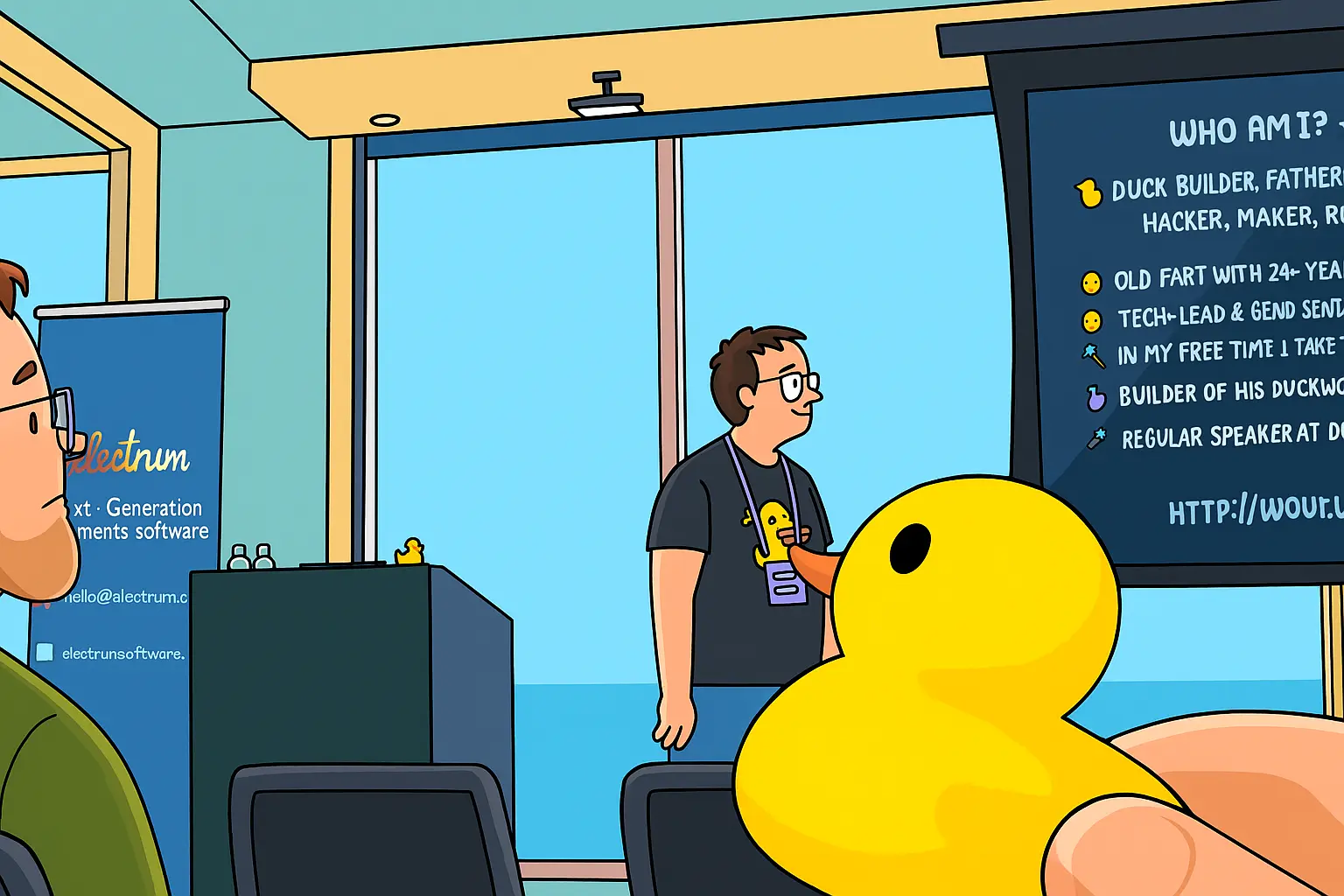 The next talk I saw was from a new speaker to me, Louise Schmidtgen. She delivered my favorite type of talk: an honest review of a real-world failure, what was learned, and how they would avoid it in the future. I’ll absolutely be at her talks in the future.
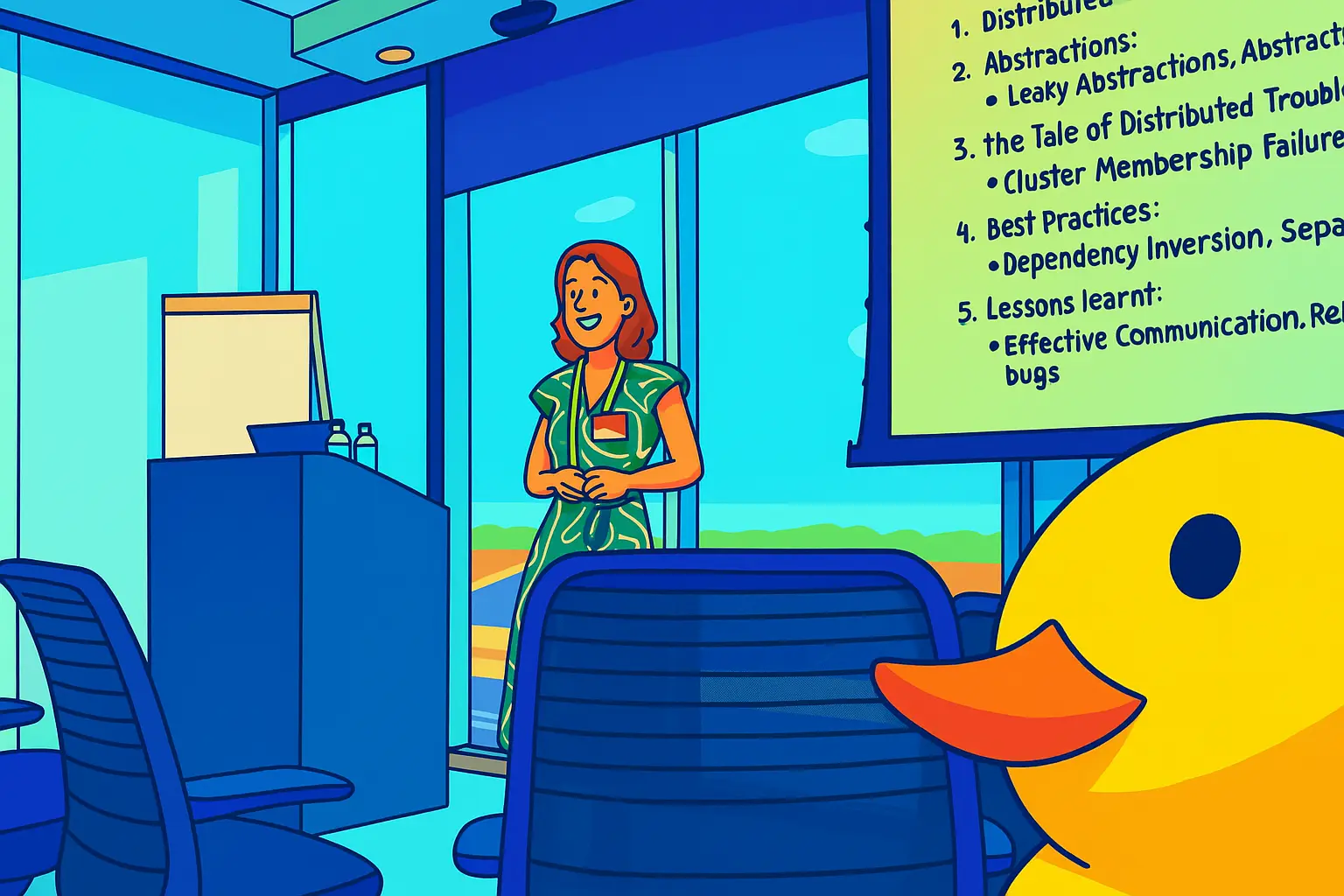 The final talk of the day was Mark Birch's. I had zero interest in seeing this talk from the title, "Community as Code: Engineering Human Infrastructure," especially since, like most attendees, I hadn’t even read the description. But, as I’ve said before, conferences are a serendipity gold mine, and this is yet another example of it—but not the last one of the day.
For me, this talk felt like it was designed perfectly for me. I was wowed and definitely need to get his book—Community in a Box.
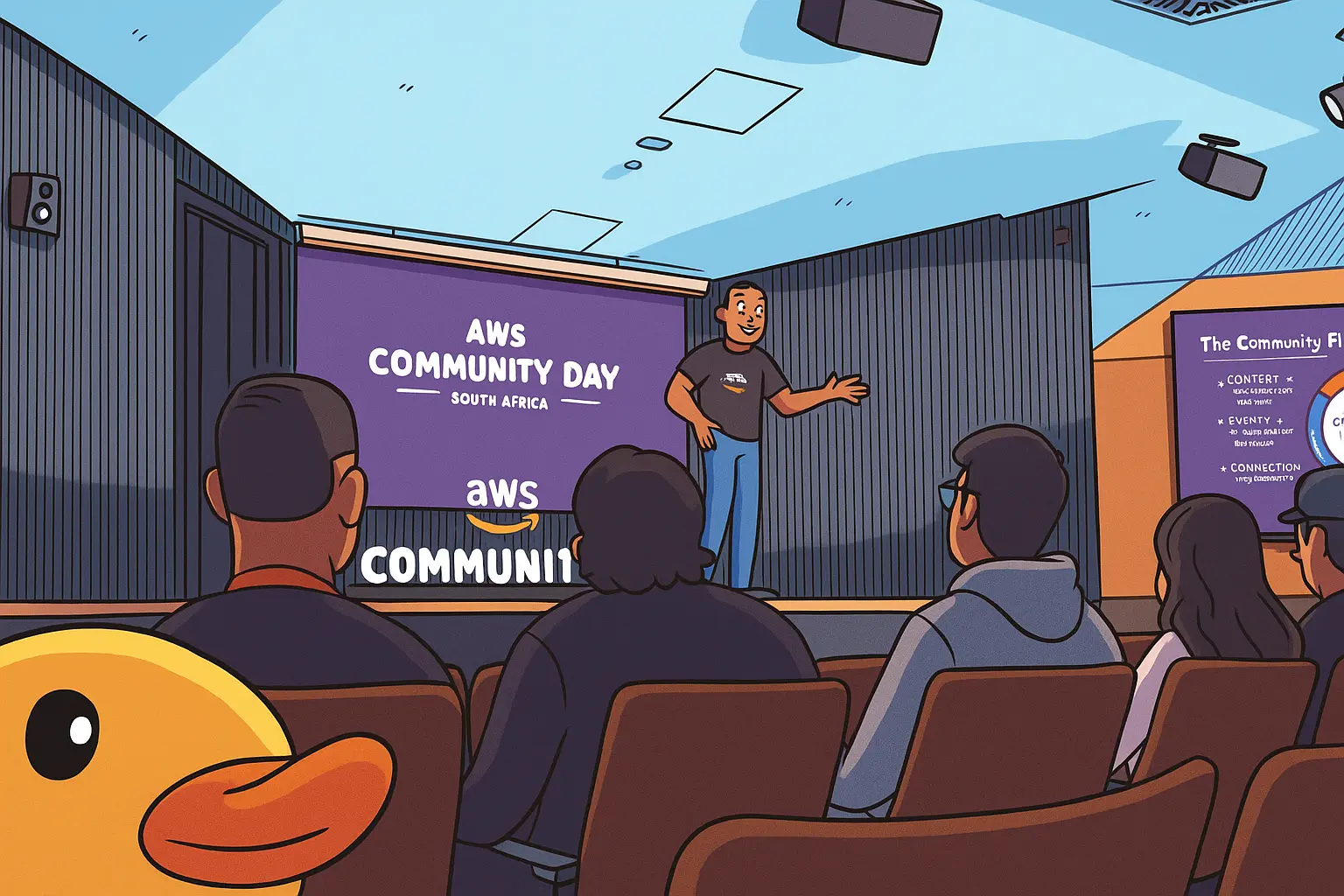 Following the day, I got an invitation to the speakers' dinner, and again, I just ended up in the right seat (thanks, serendipity) for an amazing night of discussion and inspiration. I got to hear from Jared Naude, Lindelani Mbatha, Roberto Arico, and Liza Cullis. I am still in awe of their skills and so grateful for them sharing their wisdom and stories with me.
This day wasn’t perfect, unfortunately. The venue had some rather short-sighted restrictions on movement and taking photos—which is why the images in my post are cartoons I "drew myself" (and not from photos I sneakily took and had an AI alter 🙄). The venue also extended lunch without consulting the organizers, which led to the last time slot of the day being canceled. I appreciate that the venue staff were trying their best, but decisions like that needed to be made by the organizers, not the venue. This meant that Candice Grobler, whose talks always blow me away, didn’t get to present—a huge disappointment for me.
 I hope this serves as a lesson for the venue to improve, because their reputation is in bad shape right now. It was amazing to see how Hennie and the team coped with the challenges; they truly did an amazing job despite the venue.
I cannot wait for the 2026 event! I’ll be getting tickets as soon as they come out.
My experience at yesterday's DataConf, a fantastic event organised by two people I adore, Candice Mesk and Mercia Malan, perfectly illustrates this. My day began as usual: catching up with friends and desperately trying to convince the Bootlegger Coffee people to open early just for me. ☕ I had my first serendipitous moment before the day even began. Quinn Grace asked me what I thought comes after AI. The conversation and the ideas that came from that discussion were awesome, and I’m still thinking about it as I write this.
Another moment of serendipity happened after lunch. I was unsure which talk to attend, so I simply stayed in the main room without even really knowing what the talk was about. It turned out to be the most practical talk of the day for me: "How to craft teams of exceptional analysts" by Lisema Matsietsi. The title alone screamed this was not for me, and like many attendees, I never read the description—so I was flying blind. This was pure serendipity. The talk was entirely leadership-focused and helped illuminate parts of team dynamics I hadn’t deeply understood. I’m so glad it was at the event; it just goes to show how you can end up in the right room at the right time—despite yourself.
The Learning Was in the Talks
I initially thought I’d written enough on the topic, but Duncan Dudley told me my posts were too short. I also thought I’d steal a page from Dale Nunns’s wonderful post on the event (he even has photos... I’m way too lazy for that). So here are some of the actual learnings that happened for me.
I had the pleasure of watching certified genius (certified by me—still counts) Michael Johnson talk about data engineering. As the resident "not data" guy, his talk was incredibly useful, giving a wonderful look at the history of the field and why we’re where we are. It really helped me understand the landscape better.
This was followed by Pippa Hillebrand, who has the genius and laser focus of your favorite super villain—but without the desire to take over the world. Her talk on AI privacy was so powerful, focusing not on how we build AIs, but on how we run them and the risks involved. Pippa’s talk was a perfect lead-in for the funniest and most genuine speaker of the day, Georgina Armstrong. Her talk on recommender systems was genius. I wish DataConf had recorded these talks because hers is a must-see—if for no other reason than so my partner didn’t have to listen to me go over every detail when I got home.
I’ve already mentioned Lisema’s talk, so I’ll move on to Marijn Hazelbag, PhD’s talk on digital twins with cellphones and fiber networks. While it was entirely pointless to my work, it was so interesting (extra points for the only live demo of the day, which helped captivate me even more). It opened a door to a world I didn’t know existed. I have no idea if I’ll ever need that knowledge, but serendipity may have a plan for it.
The talks of the day concluded with Carike Blignaut-Staden, who gave a must-see talk for any team building a dashboard. I’ve been guilty of doing all the things she said you shouldn’t do—which is a great place to learn from, because it’s all about improving from there.
What a wonderful day. I hope this encourages you to try a conference. And when you do, maybe skip a talk to discuss the future of work or go to a talk you wouldn’t normally have chosen. It just might lead to an even better experience.
Originally posted to my LinkedIn but thought I’d share here too for those who don’t follow me there: Serendipity at a Conference.

